
Day 3: Instructional Goals and Objectives
Instructional Goals
If Instructional Design is viewed as a journey, then Instructional Design projects are rarely Point A to Point B scenarios. In most cases, these projects have multiple stops along the way and some pre-defined routes that must be utilized. Instructional Goals provide a roadmap for Instructional Design projects to help ensure that instructional designers (IDs) don’t lose track of the destination.
An Instructional Goal is often a generalized statement about the intent of the instruction such as, “Students will recognize the value of setting instructional goals and objectives” (Brown & Green, 2020).
Instructional goals are good for defining overall ideas without setting specifics. Notice that the goal above is very general in nature (Brown & Green, 2020). It sets a destination but doesn’t map out how the project will get there.
Instructional Objectives
If goals are the roadmaps for where instructional design projects intend to go, Instructional Objectives are the specific routes that the project will use to accomplish those goals.
Instructional Objectives are much more specific than goals and talk about how and what will be achieved (Brown & Green, 2020). Instructional Objectives use action verbs and spell out measurable, expected results. “Students will demonstrate knowledge of the differences between instructional goals and objectives” would be an effective instructional objective.
The instructional objective above includes an action verb, “demonstrate,” and a measurable result, “differences between instructional goals and objectives.” Achievement of this objective can be assessed through testing of the learner.
Bloom’s Taxonomy of Educational Objectives: Cognitive Domain
Following is an incomplete list of action verbs taken from Bloom’s Taxonomy of Educational Objectives: Cognitive Domain (Newton et al., 2020).
Verbs are listed in order of complexity, starting with the most basic achievement – Knowledge – and finishing with Evaluation: the most complex achievement.
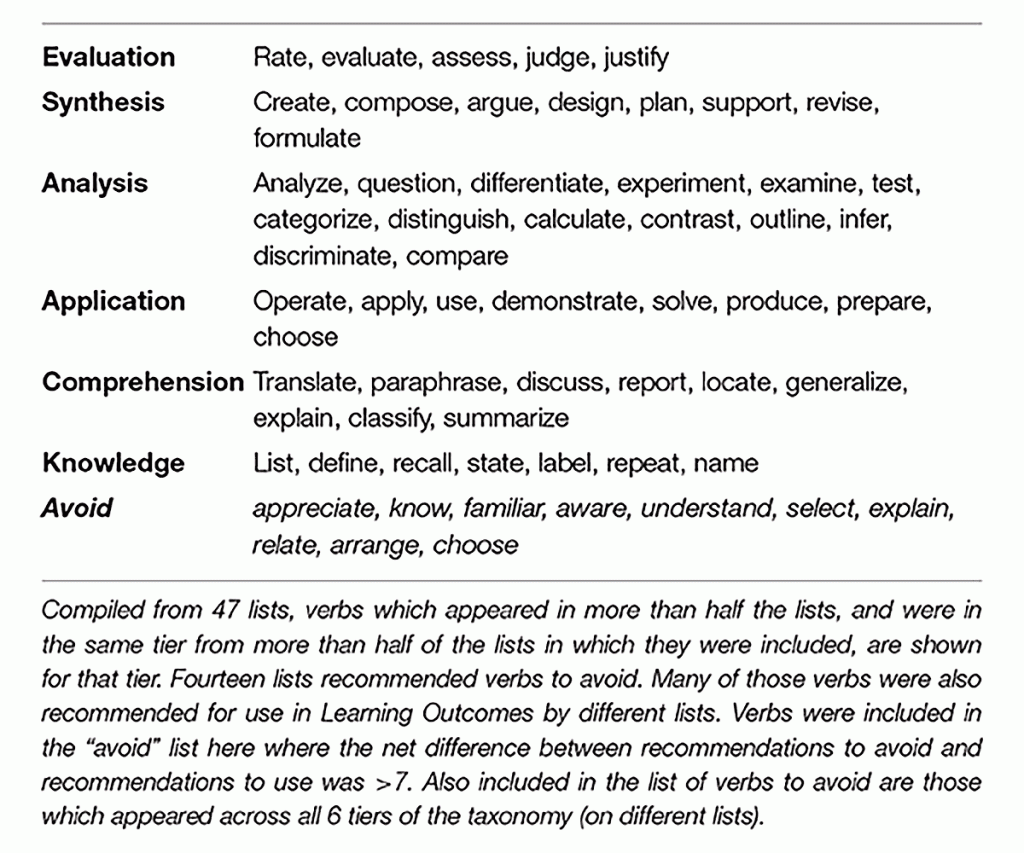
Figure 1: A Pragmatic Master List of Action Verbs for
Bloom’s Taxonomy. From Frontiers in Education.
(Click to Enlarge)
Level 1: Knowledge
- List
- Define
- Name
Level 2: Comprehension
- Discuss
- Explain
- Summarize
Level 3: Application
- Apply
- Demonstrate
- Choose
Level 4: Analysis
- Analyze
- Categorize
- Compare
Level 5: Synthesis
- Compose
- Design
- Plan
Level 6: Evaluation
- Rate
- Evaluate
- Assess
Check your knowledge
References
Brown, A. H., & Green, T. D. (2020). The essentials of instructional design: Connecting fundamental principles with process and practice (4th ed.). Routledge.
Newton, P. M., Silva, A. D., & Peters, L. G. (2020). A Pragmatic Master List of Action Verbs for Bloom’s Taxonomy. Frontiers in Education, 5. https://doi.org/10.3389/feduc.2020.00107